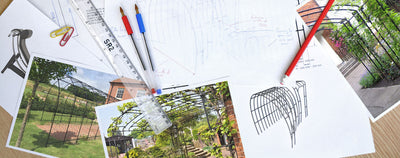

Roses have shaped gardens for centuries - from formal European estates to American cottage gardens and contemporary landscapes. Today’s outdoor spaces, however, demand more than seasonal color. They favor structure, longevity, and year-round presence. Increasingly, classic climbing roses are being trained on metalwork that feels architectural as well as decorative.
When thoughtfully chosen, structures don’t compete with roses - they enhance them. They shape growth, improve flowering, and introduce visual anchors that remain long after petals fall. At Agriframes, our handcrafted steel structures are designed not as accessories, but as integral elements in growing healthy, beautifully trained roses that become lasting highlights in the landscape.
Why Metal Structures Work So Well with Roses
Climbing and rambling roses are naturally vigorous. Without guidance, they can quickly become tangled, top-heavy, or produce uneven flowering.
Strong, well-proportioned metalwork allows you to direct growth intentionally.
Agriframes steel structures offer practical advantages:
- Strength and stability for mature plants
- Open frameworks that encourage airflow and reduce disease pressure
- The ability to tie stems horizontally for improved flowering
- A permanent framework that looks attractive even in winter
In climates with hot summers, heavy rainfall, or strong seasonal shifts - from the Northeast to the Pacific Northwest - durable metal support becomes even more important.
Just as importantly, well-designed structures bring clarity to the garden before roses even begin to leaf out.


Training Roses Over a Round Arch
Few garden moments are as inviting as a rose-covered arch.
An Agriframes Round Arch creates a welcoming transition between spaces - framing a pathway, marking an entry point, or softening the approach to a porch or gate.
The key to success lies in training technique. Instead of allowing stems to grow straight upward, gently guide them along the curve of the arch. When canes are positioned horizontally or in soft arcs, they produce more lateral shoots - and therefore more flowers - along their length.
The curved metal lines contrast beautifully with the softness of rose growth, creating balance rather than excess.
Suitable climbers across US zones include:
- ‘New Dawn’
- ‘Eden’
- ‘The Generous Gardener’
- ‘Zephirine Drouhin’
In warmer regions, repeat-flowering climbers benefit especially from structured training.


Using Obelisks for Height and Control
The obelisk remains one of the most versatile rose supports - particularly effective in borders and mixed planting schemes.
Compact climbing roses or vigorous shrub roses can be trained vertically on an obelisk to introduce height without overwhelming surrounding plants. In smaller suburban gardens or urban backyards, this vertical strategy maximizes impact without expanding footprint.
Obelisks are especially useful when:
- Space is limited
- A focal point is needed within a border
- Repetition is used to create rhythm
- Height is required without bulk
As the rose matures, foliage gradually softens the framework. In winter, the steel silhouette remains - maintaining structure even when growth recedes.


Screens as Rose Supports
Agriframes screens offer a contemporary way to train roses against walls, fences, or as freestanding dividers.
Their grid structure makes tying stems straightforward and encourages even distribution of growth. In regions where privacy is important, screens allow you to create living walls without the heaviness of solid fencing.
Screens are ideal for:
- Training climbers flat for maximizing blooms
- Creating seasonal privacy
- Softening hard boundaries
- Adding vertical interest in tight spaces
When roses are fan-trained across a screen, airflow improves and flowering becomes more consistent - a practical advantage in humid climates.


The Round Pergola as a Focal Point
For a more immersive experience, few structures rival a round pergola.
Roses trained over and around a circular steel framework create an outdoor “room” - an architectural moment that feels enclosed yet open to the sky. The circular form encourages balanced growth and even distribution of flowering.
By guiding canes horizontally along the structure, flowering increases along the full length of each stem. The result is abundant, but controlled.
In larger American landscapes, a round pergola can anchor:
- A seating area
- A garden transition
- A courtyard
- A formal lawn edge
It becomes more than plant support - it becomes your go-to favourite garden spot.


A Modern Approach to a Classic Pairing
Combining roses with Agriframes steel structures is not about nostalgia. It is about helping roses thrive while bringing year-round form to the landscape.
Whether training climbers over an arch, adding height with an obelisk, using screens for structured privacy, or creating a statement with a round pergola, traditional metalwork provides a framework that improves with time.
Strong structure allows roses to perform at their best - season after season - while giving the garden clarity, balance, and enduring presence.